Which of the Following Questions Can Help During the First Stage of Sop Development
.jpg)
As the tired old saying goes, there are tons of moving parts in a business or organization of any size.
Ofttimes, the difference betwixt a productive, successful business and a not-so-successful one is whether or not these myriad "parts" are moving in concert with i some other. This tin be the difference betwixt a finely-tuned machine and ane that regularly breaks down—and eventually falls autonomously.
For your organization to run similar such a finely-tuned machine (and to avert falling apart at the seams), your team members need to exist on the same page at all times—both literally and figuratively.
This is where a standard operating procedure or SOP comes into play.
In this article, we're going to get more than into:
- What is SOP
- Types of standard operating procedures
- Why standard operating procedures are important
- Challenges of developing standard operating procedures
- Guidelines for writing and developing constructive standard operating procedures
What Is An SOP?
A standard operating procedure (SOP) is a document that provides articulate-cut directions and instructions every bit to how teams and members inside an organization must get well-nigh completing certain processes.
Note that SOP documentation is much more than involved than a simple procedural document. The chief difference existence that process documentation is meant to provide a high-level overview of the process in question, while SOPs provide an "on-the-footing" explanation of what needs to happen to ensure a given process goes as planned.
(That is, a procedure-focused document typically explains that the organization will go from "Point A" to "Indicate B," while an accompanying SOP volition describe everything the organization will do in gild to go to "Point B.")
Types of Standard Operating Procedures
While companies are free to develop their internal SOP documents in a format that works best for their team, most organizations choose from one of the post-obit formats.
Step-by-Step Format
In some cases, it may be sufficient to create a elementary numbered or bulleted list of steps to take when completing a process.
This format should be used only when the process in question is straightforward and, in the vast majority of circumstances, can be completed without neglect.
Processes in which a step-by-stride format is likely sufficient include:
- Setup and cleanup instructions
- Digital login sequences
- Instructions for proper and safe use of equipment
Hierarchical Format
The hierarchical format for SOPs borrows from the above format in that information technology involves listing the steps of the process to be completed.
Even so, hierarchical SOPs provide additional details within each step every bit accounted necessary. While a purely step-by-step SOP will list steps 1, 2, 3, and and so forth, a hierarchical SOP may include Steps 1a and 1b; 2a, 2b, 2c; 3a, 3b.
The hierarchical format is used when more instruction may be needed in guild to sufficiently complete a given job. Every bit a simple instance, if Step 1 tells team members to log into their account, Stride 1a may direct individuals to input their username, with Step 1b directing them to input their password.
Flowchart Format
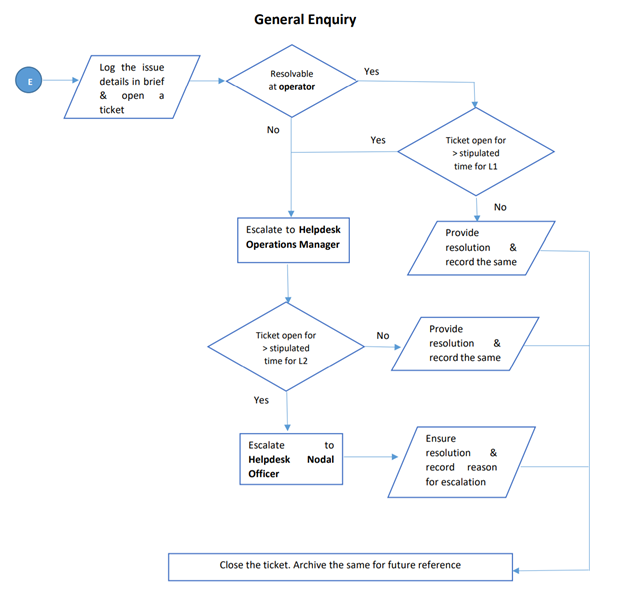
Flowcharts are best used to illustrate SOPs when multiple outcomes are possible at sure points throughout the procedure.
In such cases, the result of one footstep will impact the style in which the team volition need to approach each subsequent footstep.
Accept a look at the following workflow, for instance:
(Source)
Note that, in this example, in that location are multiple times in which a decision must be made every bit to how to go on. Basically, each subsequent step depends on the event of the previous step—and it simply wouldn't be logical to follow sure paths if a contrasting outcome were to come about.
Why is a Standard Operating Procedure Of import?
Though we've hinted at this from the start of our discussion here, permit'due south make clear:
Standard operating procedure documentation is important because it allows organizations to systematize their processes, go on all team members and other stakeholders on the same page at all times, and movement forrard in a singular, cohesive manner.
Perhaps the best way to illustrate the importance of developing SOP documentation is to consider the negative touch of non doing so. Basically, information technology leaves too much upwards to chance: There's no guarantee that best practices will be followed at all times, that all team members volition remain in alignment, or that the organisation will go along to operate in a positive and effective manner.
Permit'south accept a moment to dig a flake deeper into what creating SOP documentation can exercise for your organization.
Ensures Adherence to Best Practices
With SOP in place, adherence to best practices regarding all organizational processes is not merely a suggestion, but a mandate.
(It'south worth noting that said "best practices" should be defined by the unabridged team of stakeholders involved in the processes in question. In involving squad members from all departments and hierarchical tiers in the process of developing SOP, y'all can exist sure that your team is always interim in the all-time interest of the company. More on this in a fleck.)
The point is, creating SOP provides not only a "true north" for your team to strive toward, but likewise a clearly-fatigued map to guide them along the fashion. This improves the chances of experiencing a positive outcome in a given state of affairs, while too minimizing the chances of encountering any obstacles throughout the process.
Information technology'southward simple: Developing SOP ensures your team knows the most efficient and effective way to go virtually a certain chore. This means you lot'll be expending fewer resource to experience optimal results, regardless of the task at paw.
Ensures Consistency
As nosotros've said, developing SOP better enables your organization to run like a finely-tuned machine.
A huge function of running "like a machine" is consistency. Following SOP ensures that your team will always know the right path to have—and will always take this path when necessary.
Simply put: SOP makes both decisions and processes more automated for your squad at all times.
Enables Proper Onboarding and Training
In clearly defining standard operating procedures inside your organization, you'll inherently make employee onboarding easier as well as better how you railroad train your team members with regard to best practices in certain situations.
Since one of the goals of creating SOP is to go out no stone unturned in terms of contingent circumstances, you'll have a better idea of what these potential circumstances are—leaving you lot better prepared to train your employees equally to how to navigate them.
(In dissimilarity, in not having conspicuously-defined SOPs in place, you run the take a chance of leaving your team uninformed and unprepared to handle certain challenges as they come up about.)
Maintains Organizational Cognition
For the sake of argument, let's say your team already knows exactly how to handle any situation that comes their way—and is always able to practice so effectively and efficiently.
In this instance, it may seem like documenting everything your squad already knows would exist a waste product of time, money, and other resources. After all, everyone knows what to do, so why have the time to write down everything they already know?
The problem, though, is that your squad isn't going to remain intact as-is forever. Employees will retire, quit, be promoted, get on leave...the list goes on. When that happens, you need to know that the noesis and expertise they've brought to the organization will stay within the arrangement.
In documenting your SOP, yous'll ensure this info stays inside your company—assuasive new team members to pick up correct where the erstwhile ones exit off.
What are the Challenges of Developing a Standard Operating Procedure?
While there are many benefits to developing SOPs inside your organisation, doing and so comes with its fair share of challenges, besides.
Compartmentalized Development
There'southward a reason your development of SOPs should be an "all-hands-on-deck" thing:
Basically, if simply certain stakeholders are involved, you lot'll run the risk of your SOPs missing the marking in some way or another.
For instance, if an SOP is created solely by C-level executives, information technology may focus more than on the goal to be attained than the process required to attain it. This tin can crusade the ground-level team to run into a variety of obstacles that the executives may not take predictable—meaning the SOP in question actually isn't in-line with what would be considered "all-time practices" for the given circumstances.
On the other paw, if created solely past managerial staff, the SOP may not take into consideration C-level goals, such equally minimizing resources consumption and improving the bottom line. In this scenario, you lot may have on-the-footing teams completing tasks in a way that may seem efficient, but that isn't really doing all that much for the business as a whole.
That said, the procedure of developing SOP needs to involve all stakeholders at all times. This will ensure that the processes being developed are fabricated in the all-time involvement of the company.
Problems with Accessibility, Visibility, and Centralization of Information
Even after standard operating procedures have been adult, you'll demand to ensure that all stakeholders are able to access and engage with said documentation whenever necessary.
Without this accessibility and visibility, it tin can be pretty easy for SOP to fall to the backburner—leading team members to go back to the "quondam mode of doing things." Evidently, this defeats the purpose of developing SOP in the first place.
Moreover, it'south essential that the SOP documentation your various team members have admission to is the exact same documentation across the board. The almost constructive mode to ensure this is to go on the certificate in a centralized database that all stakeholders have access to. That way, yous tin guarantee that all team members are following the right documentation at all times.
(Learn more about how a centralized internal database tin better enable your system by checking out our guide on knowledge management systems.)
Lack of Management and Maintenance
Regarding management and maintenance of SOP, there are ii primary challenges to consider:
Outset, your squad will need to be properly trained and prepared as to how to actually implement the procedures in question. This means ensuring they have access to whatsoever equipment or other resources needed to complete the tasks divers inside the SOP—and that they know how to efficiently and effectively use these resources. If this slice of the puzzle is missing, your team only won't be able to act in accordance with SOP—no matter how clear the document may be.
It's also worth noting that what's considered the all-time form of action for the time being may non always be so. Improvements in technology, personnel changes, and a multifariousness of other factors may require your team to revisit previously-adult SOP as fourth dimension goes on. If the SOP your team follows is outdated or obsolete in whatsoever way, continuing to follow it will end up doing more harm than skillful to your organization.
How to Write a Standard Operating Process
Now that we understand what a standard operating process is, why it'south important, and the challenges involved in creating and implementing SOP, the adjacent stride is to actually write and develop your standard operating procedures.
Sign up for a 14-day free trialand meet how Helpjuice's cognition base of operations software tin help organize your SOP's and ameliorate your internal processes.
Below are the general steps to accept when writing a standard operating procedure.
- Determining Your Goals for Creating an SOP
- Decide the Stakeholders and Creators
- Ascertain the Terminate-User
- Determine the Scope and Format of the SOP
- What Should Be Included in Your SOP
- Review the Written Certificate
- Train Your End-Users
- Test and Tweak the SOP in Practice
- Implement SOP—and Revisit Regularly
Now, let'south discuss in more detail what the process of developing SOP documentation should wait like.
ane. Determine Your Goals for Creating an SOP
Before you even begin writing an SOP, you need to have a clear-cut reply to the question of why you lot're creating the document in the first place.
On the positive side, you'll desire to ask questions such as:
- How will SOP allow employees and teams to work more efficiently?
- How volition post-obit an SOP permit the squad to ameliorate serve our clientele?
- How will following an SOP bear upon the company's bottom line?
You'll also want to place any pain points or obstacles that currently be inside your organization'south processes. This will allow yous to exist more specific in determining exactly how your team will exist more productive with SOP in identify.
In setting SMART goals for your SOP-related initiatives, you'll:
- Be better able to develop absolute best practices
- Have a clearer thought of how implementing SOP will affect your arrangement
- Know specifically what to look for when unrolling and assessing SOP over time
Hither—and in each subsequent stage of this process—is where a robust internal noesis base of operations can enable your squad to maximize productivity.
For instance, you may have already created informal documents regarding your diverse processes, which you lot can apply as a springboard when developing a more formal SOP. Or, you may have a list of business concern- and/or team-related goals that yous've been striving for—which, once more, volition make information technology easier to solidify your goals for the current SOP at hand.
2. Determine the Stakeholders and Creators
As nosotros've noted, any and all personnel who will be engaging in or impacted by SOP should have some say in the cosmos of the document.
By and large speaking, your SOP development squad should consist of:
- C-level executives, who will be focusing on developing lean operations in an effort to attain high-level business organisation goals
- Management leaders to develop best practices, ascertain necessary utilize of resources and equipment, and determine a plan for implementing SOP
- Footing-level employees to determine the validity and plausibility of the SOP in terms of logistics and resources consumption
You'll also need to determine who, specifically, volition be responsible for actually writing the document. Whether you rely on your electric current staff or a 3rd-party entity on a freelance basis, it's vital that the creator of your SOP specializes in technical writing and has in-depth knowledge and experience of your company'due south processes and your industry as a whole.
Furthermore, while your customers won't necessarily be involved in creating the document, you do want to keep their all-time interest in mind whenever necessary, every bit well. While SOP typically refers to internal, behind-the-scenes processes, said processes will likely impact the customer experience in some way or another—meaning yous should never permit your target audition skid to the back of your listen as you develop SOP within your organization.
3. Define the End-User
While a diverseness of individuals will be involved in the cosmos of SOP, the bodily content of the document will invariably exist used past a select target audience.
(For example, in defining an SOP for the handling of customer service requests, your customer service reps would be the key individuals the document was created for.)
That said, information technology's important that yous know who will actually be engaging in the procedures in question, equally this will enable you to create the SOP document with these individuals in mind. The thought hither is to be able to create the document in such a style as to be useful to those who will really implement the procedures defined within said certificate.
This means:
- Remaining laser-focused on the actual duties of the end-user
- Using the correct language and terminology, equally expected by the end-user
- Explaining sure terminology equally needed, while not over-explaining processes and terms that are second-nature to the cease-user
But, before you tin can make any of this happen, you demand to take a clear idea of who within your organisation your SOP is being created for.
iv. Determine the Scope and Format of the SOP
As nosotros discussed earlier, an SOP document typically takes one of three forms:
- Stride-by-stride list
- Hierarchical list
- Flowchart
Depending on the procedures beingness documented, you'll want to determine which of these formats will be near effective in communicating the desired information.
The all-time course of action here is to become with the simplest format necessary for the circumstance at hand. If in that location'southward no need to include additional explanation or potential contingencies, a footstep-by-step listing may be sufficient; if each step in the process can potentially lead to multiple outcomes, a flowchart is likely necessary.
five. Outline the SOP Document—and Begin Writing It
Once you know what your goals are for creating SOP, who volition be involved in creating it, and the best format to use, you can begin planning out the document as a whole.
Here, nosotros'll hash out the various parts of a consummate SOP document, explaining what information should be included in each.
Title Folio
The title folio of your SOP should contain identifying information regarding the document, including:
- The SOP being documented
- The certificate's unique identification number
- The date of creation and/or editing of the document
- The department or professional title of the entity who volition implement the SOP
- The names and titles of the individuals who created the document
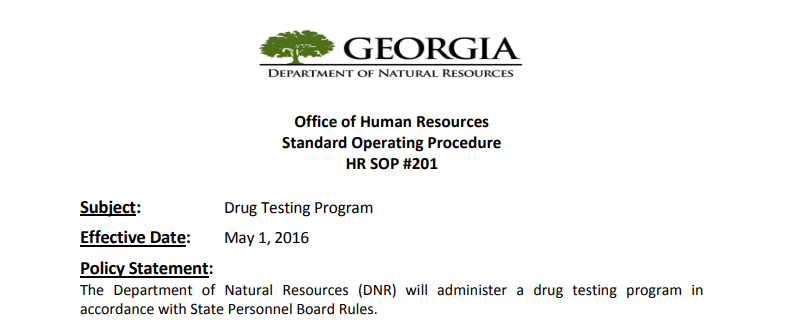
(Source. Instance of SOP Championship Page From Georgia's Section of Natural Resource' Hour Team)
Table of Contents
If necessary, you can include a tabular array of contents after the title page of your SOP, as this will help those who use the document find the information they're seeking with relative ease.
This may only be necessary if the SOP document is longer than a page or two. Basically, if the end-user is able to quickly and easily find the information they need without a table of contents, you likely don't need to include it in the document.
Preparatory Information
Equally we've discussed, certain information will demand to exist laid out in full in gild for your squad to exist able to adhere to the SOP to be described momentarily.
This preliminary information includes:
- SOP Purpose: Here, you'll explain your team's rationale for creating the SOP certificate. This means explaining the high-level and "on-the-ground" impact yous hope the SOP to have on your arrangement, as well equally the actual standards to be met by implementing the SOP.
- Roles and Responsibilities: In this section, you'll identify the specific employees or stakeholders to be involved in a given process. Moreover, you'll also ascertain the capacity of these individuals within your organisation, as well as the office they play in the SOP in question.
- Resources and Materials: The individuals responsible for completing the procedure will likely need to employ a diversity of tools, engineering, and other materials throughout the process. Hither, you lot'll define what these resource are, and any other necessary information virtually them (due east.yard., where to detect them within your facilities, how to store them properly, and how and when to asking maintenance if need be).
- Cautions, Warnings, and Other Hazard-Related Info: If any safety precautions exist with regard to the aforementioned resources, or to the overall procedure in question, it's imperative that yous lay them out clearly, here. This data should also be present within the SOP documentation to follow, with clear indicators of how to find more than information if needed.
Methodology and Procedures
This department is, of course, the near of import part of the overall SOP document, as information technology's where yous'll describe the actual operating procedures to be followed at all times when completing a sure task.
Using the chosen format, your job hither volition be to develop detailed, footstep-by-pace instructions for the end-user to follow at every touchpoint. In more simplified cases, these steps will exist sequential; in others, the process may involve sub-steps, recursive processes, decision copse, and the like.
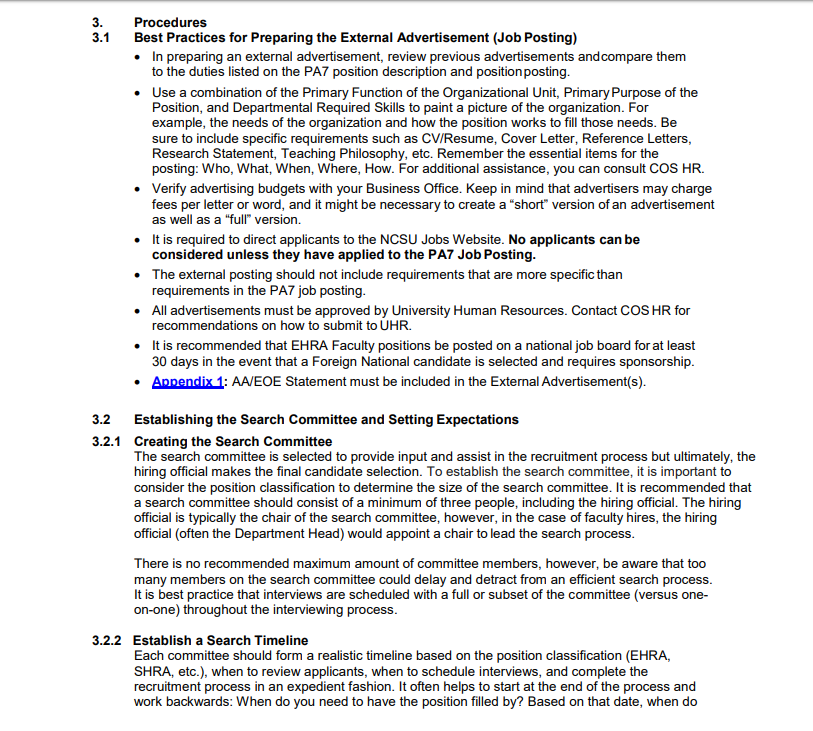
(Source. Example of Procedural Steps From NC Land University)
As we've discussed, it'southward essential to be equally detailed and clear as necessary throughout this section of the SOP. The goal is to employ as specific language as is needed to communicate instructions in total—and to minimize whatsoever ambivalence that may exist within said instructions.
(To that indicate, it's worth noting that you only need to exist specific plenty for the intended audience to understand the instructions in question. In other words, there's no need to be specific to the point of beingness pedantic; make your instructions clear, and so let the end-user to become to piece of work.)
Depending on the process in question, yous'll also want to include any diagrams, illustrations, or other imagery that may supplement your written documentation. In fact, it may be more constructive and efficient to use such illustrations in certain circumstances where the written give-and-take but doesn't suffice.
Quality Command and Balls
It's essential that your squad members are able to assess their performance with regard to SOP on a case-past-instance footing and at specifically-divers intervals over time.
In this section, then, you'll want to include documentation that allows them to do then. This may include:
- Anecdotes illustrating best practices with regard to a specific procedure
- Rubrics or similar means of measuring performance
- Samples (existent or simulated) of past performance evaluations
While the "meat" of your SOP should exist as detailed equally possible, this department will ensure that your team members continue to adhere to SOP to the best of their abilities—and are too able to identify areas in which they may need to make improvements moving forrad.
References and Glossary
You'll likely refer to a variety of terms, resources, and other documents throughout a given SOP that may crave further explanation.
In this section, you lot'll be able to either provide this explanation in the necessary item, or point your audience toward additional resource or documentation for further caption. This will allow you to maintain a singular focus within the current SOP certificate, while also providing the opportunity for the stop-user to dig deeper into a given topic should they need to do so.
6. Review the Written Document
Once y'all've written the document in total, you'll want to provide all stakeholders the opportunity to review information technology for accuracy, cohesiveness, and comprehensiveness.
Throughout this stage of the procedure, all involved parties should accept note of any questions, concerns, or other problems they uncovered while reading through the document. This will allow you to brand specific and focused amendments to your SOP earlier "officially" unrolling it.
Now, you lot of course want the end-user's advice and suggestions to play a heavy part here. After all, they're the ones who will exist engaging in the process at hand, so you'll want to know with certainty that they understand everything presented within the certificate. Moreover, since they have showtime-mitt feel with the processes in question, they'll be able to place areas that may have been disregarded when initially creating the document.
But, you too may want to accept the document reviewed by those with less experience with the processes in question. This will help y'all business relationship for any "blindspots" your more experienced team members may have specifically due to their experience and expertise. This, in turn, will enable new hires to rapidly go "up to speed" with SOP in one case they come up aboard.
vii. Train Your End-Users
No matter how experienced or specialized your current team members are, they will need to be trained (and/or retrained) equally to the new SOP to be implemented.
This, of class, can be a sensitive area—especially for long-fourth dimension employees who are used to going about tasks in a certain way, and who may not notwithstanding see the benefits of making the necessary improvements.
For this reason, it'due south vital that these training sessions occur in a relaxed, no-risk atmosphere. Your squad needs to have total conviction that this isn't a "gotcha"-blazon ordeal; rather, it'southward to better enable them to put their best foot forward, and to be as productive as possible in their contractual duties.
As we'll discuss in the following sections, you'll also want to betoken out to your team that this preparation isn't just a one-off thing—it'south an ongoing process. This will reinforce the idea that the new SOP is and will be the new way of doing things, and will non be put to the backburner subsequently the novelty of the new process wears off.
That said, the thought of preparation your team with regard to new SOP deals only in part with the actual procedures in question, while focusing more on instilling in your squad a growth mindset.
8. Exam and Tweak the SOP in Practice
Piggybacking off the last point, yous want to gradually immerse your squad in the new SOP (rather than forcing them to dive in).
This may, at first, involve having your team piece of work through the new SOP in a fake environment. Here, you might prepare dissimilar scenarios in which sure team members play different roles, allowing each individual to get a feel for the new processes. Or, you might but hash out hypothetical situations with your team in an open environment, allowing your squad to verbally walk through the processes to be completed in said scenarios.
As your team becomes more acclimated to the new processes, you might then brainstorm unrolling the new SOP to "real-globe" scenarios. While there's no "one mode" to go most doing so, you might identify sure team members who are more than prepared than others and allow them to dive in first—then have them railroad train other team members in the specific areas they demand aid with.
Again, though:
This gradual unrolling needs to exist intentional, and it requires that all team members actively work to make progress toward the new manner of doing things. While you'll want to allow for some leniency during the initial rollout, beingness likewise lax tin can cause your team to revert back to the much-less-efficient processes from days past.
9. Implement SOP—and Revisit Regularly
The "final" stage of the process is, of grade, to implement the new SOP in full.
We put the word "final" in quotation marks because, again, what's considered "best practices" in a given scenario is constantly in flux. To be sure, what works best today may be a rather inefficient fashion to go about doing things mere months from now.
This is why information technology's important to instill a growth mindset in your team: They need to understand that the new processes are not ready in stone, and will evolve over time as the need arises.
Not merely practise they need to understand this—they also demand to be a part of information technology. Equally your team continues to adhere to the new SOP, they should regularly take note of any positive or negative experiences they have along the way. Basically, this means noticing areas of improvement, too every bit areas in which more than improvements demand to be made.
In addition to any "on-the-fly" noticing, your team should also run across regularly to discuss further plans for moving forrad. Typically, this will mean amending the SOP in relatively pocket-sized ways—just could also involve rebuilding the entire document from scratch, if need be.
It's also important to consider any external factors that may crave your team to revisit the SOP. These factors include legislative changes, technological advancements, and/or shifts in consumer needs.
In solidifying an effective and efficient SOP you allow your team to be as productive every bit possible given your organization's electric current overall circumstances—while keeping the door open up to make improvements to your processes as these circumstances alter.
Wrapping Up
Creating standard operating procedures is perhaps the all-time way to ensure your squad puts their talents to maximum usage.
In contrast, even the most talented of professionals may non be able to be productive and constructive in their position if not given proper and explicit guidance.
Moreover, even if your new SOP aligns with absolute best practices, information technology won't practise whatever practiced if your team isn't able to access it. This is why a centralized internal knowledge base of operations is vital to the implementation of a new SOP.
With clear-cut, comprehensive standard operating procedures on-mitt at all times, your team members will always know exactly what to do in any situation they face. In turn, your arrangement's productivity will all but certainly skyrocket.
Want to learn how standard operating procedures can aid with improving collaboration between teams working in a hybrid environment? Sign up for the following free webinar .

Source: https://helpjuice.com/blog/standard-operating-procedure
0 Response to "Which of the Following Questions Can Help During the First Stage of Sop Development"
Post a Comment